Someone once said that the hallmark of being a man is that once you decide you want something, you get it. No excuses, just action to get to the point where you want to be.
That's why you need goals. It's easy to meander through life without any goals and wishes, leaving you unchallenged and soft. Your life should be more like the heroes journey, continually finding new challenges to overcome. If not, how do you want to grow?
On a smaller level, this is the same reason why you want clear goals when starting anything you want to succeed at. I can't stress the use of SMART enough. Any goal you specify should conform to the SMART-principle (Specific, Measurable, Attainable, Relevant, Time-bound).
But just remember that once you have the goal, there is no turning back from the first step. Make it an active ritual. Put on your running shoes, go to your office or make a list of groceries. Clearly demarcate the boundary between going for a goal and not going for it. Ritualize it so you can form a new habit and 'step' into that new goal.
Thursday, October 6, 2011

Tuesday, October 4, 2011
Monkeys & language
After watching the first episode of "Frys planet word" where results of experiments on monkeys and primates (our closest relatives) showed that though they are able to communicate (Almost every creature communicates) they are unable to grasp speech.
Monkeys can learn sign language and are able to communicate needs and emotional states (In fact, they're pretty much hardwired to only communicate emotional states) but cannot seem to grasp the concept of grammar.
This got me thinking. A lot of philosophy is centered on the point of language. How language moulds our thoughts (As the cookie experiment by Alfred Korzybski shows with humor)
and how it influences how we perceive the world around us.
“Language shapes the way we think, and determines what we can think about.” (- Benjamin Lee Whorf)
When looking at monkeys however, it becomes clear that they lack specific brain hardware to properly develop and learn language. The hardware of your mind would merit an entire new post, but briefly said: Humans have better hardware for handling language than monkeys do, just as dolphins have better hardware for 3d-navigation than humans do.
Considering this, isn't mr Whorf mistaking cause and effect? Could it be that it isn't language that shapes thought, but that thought is a result of language? Being able to learn a language and being intelligent* are two of the things that set humans apart from animals. It would make sense that both are connected.
*Well, some of us at any rate.
Monkeys can learn sign language and are able to communicate needs and emotional states (In fact, they're pretty much hardwired to only communicate emotional states) but cannot seem to grasp the concept of grammar.
This got me thinking. A lot of philosophy is centered on the point of language. How language moulds our thoughts (As the cookie experiment by Alfred Korzybski shows with humor)
and how it influences how we perceive the world around us.
“Language shapes the way we think, and determines what we can think about.” (- Benjamin Lee Whorf)
When looking at monkeys however, it becomes clear that they lack specific brain hardware to properly develop and learn language. The hardware of your mind would merit an entire new post, but briefly said: Humans have better hardware for handling language than monkeys do, just as dolphins have better hardware for 3d-navigation than humans do.
Considering this, isn't mr Whorf mistaking cause and effect? Could it be that it isn't language that shapes thought, but that thought is a result of language? Being able to learn a language and being intelligent* are two of the things that set humans apart from animals. It would make sense that both are connected.
*Well, some of us at any rate.
Sunday, October 2, 2011
Where did that time go
A long time ago, when I was just a starry-eyed nerd starting on my computer science studies, I found a new hobby, where I met some interesting people, went camping and in general passed around bottles of varying quality and taste of alcohol around a campfire.
One day, for some reason, a canadian had joined us. When I told him about my studies and plans he told me that he didn't use computers.
I was completely surprised. They're useful! You can send e-mail, read information and do all kinds of nifty stuff!
What he told me always stuck around, in the back of my head;
"I don't use computers. A man could get old behind one of those."
And now, looking back, I have to admit it: I spent too much time behind the damn machine and lost whole years that could have been spent studying faster, finding a nicer job and generally living life more.
One day, for some reason, a canadian had joined us. When I told him about my studies and plans he told me that he didn't use computers.
I was completely surprised. They're useful! You can send e-mail, read information and do all kinds of nifty stuff!
What he told me always stuck around, in the back of my head;
"I don't use computers. A man could get old behind one of those."
And now, looking back, I have to admit it: I spent too much time behind the damn machine and lost whole years that could have been spent studying faster, finding a nicer job and generally living life more.
Saturday, October 1, 2011
Weight loss
Well, it's been more than a month since I tried low-carbing / going ketogenic. And you know what? I've stopped doing it, but the weight loss seems to persist. Currently I'm still reaching my goal of 0.5 Kg / weekly, but the whole low-carbing was getting to me.
In essence, you have to starve your body of carbohydrates before you enter a ketogenic state and remain in there for a while to really start burning fat. "Needlessly complicated and hard", as a friend of mine told me.
A few things I do notice however: My protein intake has risen, partially due to the advice said friend gave me and partially due to me just eating more as a result of the ketogenic diet try-out.
The verdict on the ketogenic diet: it works pretty well, but really disrupts your eating patterns and dietary choices (Though that's the whole point). For now I'm sticking with moderate exercise and attempts to eat 'clean'.
And of course, not eating more than I need. The tip I got was trying to go for a 40-40-20 spread* (Carbohydrates, protein, fat). Let's see how that works out.
[*Edited]
In essence, you have to starve your body of carbohydrates before you enter a ketogenic state and remain in there for a while to really start burning fat. "Needlessly complicated and hard", as a friend of mine told me.
A few things I do notice however: My protein intake has risen, partially due to the advice said friend gave me and partially due to me just eating more as a result of the ketogenic diet try-out.
The verdict on the ketogenic diet: it works pretty well, but really disrupts your eating patterns and dietary choices (Though that's the whole point). For now I'm sticking with moderate exercise and attempts to eat 'clean'.
And of course, not eating more than I need. The tip I got was trying to go for a 40-40-20 spread* (Carbohydrates, protein, fat). Let's see how that works out.
[*Edited]
Thursday, September 22, 2011
Types of problems
I always thought that in essence, there are only two types of problems. Maybe I'm too much of a technician for dividing everything that could ever go wrong into two categories, but it served me well so far:
Technical problems are problems that rely on a change in the world. "My oats need to be stored", "This car is too slow", "Man, I wish my browser could do that". They might be complex, sure, but there often is a technical solution to a problem.
Human problems however, are a real pain in the backside. You can't solve human problems, you can only try to confront them or show people a way out. But there is no 'fix' for the problems a person has. And if there was, it is considered rude, as you would encroach on that holiest of holies: Someones personality, personal sphere and freedom of choice.
It's just such a shame that in my current job as technical teacher, I'm hired to give a technical solution for a human problem. The problem? Management doesn't really care about the people who work there. The solution: Let's throw some courses at them so they feel that we're helping them.
Argh.
Technical problems are problems that rely on a change in the world. "My oats need to be stored", "This car is too slow", "Man, I wish my browser could do that". They might be complex, sure, but there often is a technical solution to a problem.
Human problems however, are a real pain in the backside. You can't solve human problems, you can only try to confront them or show people a way out. But there is no 'fix' for the problems a person has. And if there was, it is considered rude, as you would encroach on that holiest of holies: Someones personality, personal sphere and freedom of choice.
It's just such a shame that in my current job as technical teacher, I'm hired to give a technical solution for a human problem. The problem? Management doesn't really care about the people who work there. The solution: Let's throw some courses at them so they feel that we're helping them.
Argh.
Tuesday, September 6, 2011
Meal components
I've always had the idea that food charts were a bit off. Every meal I've seen so far only contains 3 real types of ingredients.
Fruits, vegetables and legumes. The "green" stuff. Plants that give you vitamins, minerals and fibre, while being low in calories, so you can essentially eat a lot of them without ill effect.
Meat, fish, eggs and other sources of protein and fat. (I'm still unsure about tofu) These satiate hunger very well (Fat and protein do that) and contain those proteins you need to keep your body going. It kind of makes sense, that the best food to sustain your body is another body, as it is made of the same stuff.
And lastly, there's what I call filler: Pasta, potatoes, bread, rice, etc..
These generally give you the bulk of your energy, having a high caloric content based on carbohydrates ('carbs'). Not that there is anything wrong with calories, you need energy to live, to work and to thrive. Bread is an excellent example, a staple of humans for ages, it is essentially a slab of carbohydrates that you can take to your work so you can refill the energy you spent labouring all day.
But if you want to lose weight or want to try things like primal (paleo) eating, low-carb, or tim ferris' diet, it makes sense to cut out the bulk of energy from the diet by eliminating the filler category.
(Plus, you'll have to up your intake of greens and protein-sources a bit, so you actually do get enough energy. Which are the most tasty part of any meal. Yum!)
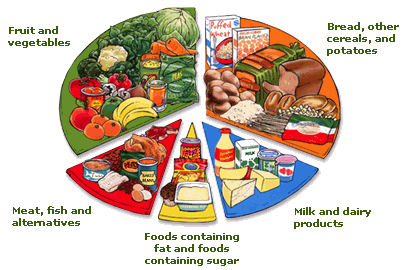
Fruits, vegetables and legumes. The "green" stuff. Plants that give you vitamins, minerals and fibre, while being low in calories, so you can essentially eat a lot of them without ill effect.
Meat, fish, eggs and other sources of protein and fat. (I'm still unsure about tofu) These satiate hunger very well (Fat and protein do that) and contain those proteins you need to keep your body going. It kind of makes sense, that the best food to sustain your body is another body, as it is made of the same stuff.
And lastly, there's what I call filler: Pasta, potatoes, bread, rice, etc..
These generally give you the bulk of your energy, having a high caloric content based on carbohydrates ('carbs'). Not that there is anything wrong with calories, you need energy to live, to work and to thrive. Bread is an excellent example, a staple of humans for ages, it is essentially a slab of carbohydrates that you can take to your work so you can refill the energy you spent labouring all day.
But if you want to lose weight or want to try things like primal (paleo) eating, low-carb, or tim ferris' diet, it makes sense to cut out the bulk of energy from the diet by eliminating the filler category.
(Plus, you'll have to up your intake of greens and protein-sources a bit, so you actually do get enough energy. Which are the most tasty part of any meal. Yum!)
Europe
The whole point of being a social animal is that you have behaviour that makes it possible to not only consider other humans as tools for darwinian steps (Eat, fuck, fight) but that we can actually build social networks with more advanced goals.
Caveman struggles to survive between other cavemen. He finds friends. Together, they achieve more. This doesn't mean that everyone needs to be lovey-dovey friends, but by simply working together, you can advance towards goals that are unattainable alone. Say a space shuttle.
The whole point is: Work together, so you can build a better world and you can better kick the ass of that other tribe.
And that's where I completely fail to understand the large and noisy mass of people whom regard the european union with abject fear and loathing. Here we are, slowly making the biggest, baddest tribe to even better kick the ass of the other tribes. And suddenly people squabble. As if a border on a map determine the way your associations are made.
Caveman struggles to survive between other cavemen. He finds friends. Together, they achieve more. This doesn't mean that everyone needs to be lovey-dovey friends, but by simply working together, you can advance towards goals that are unattainable alone. Say a space shuttle.
The whole point is: Work together, so you can build a better world and you can better kick the ass of that other tribe.
And that's where I completely fail to understand the large and noisy mass of people whom regard the european union with abject fear and loathing. Here we are, slowly making the biggest, baddest tribe to even better kick the ass of the other tribes. And suddenly people squabble. As if a border on a map determine the way your associations are made.
Subscribe to:
Posts (Atom)